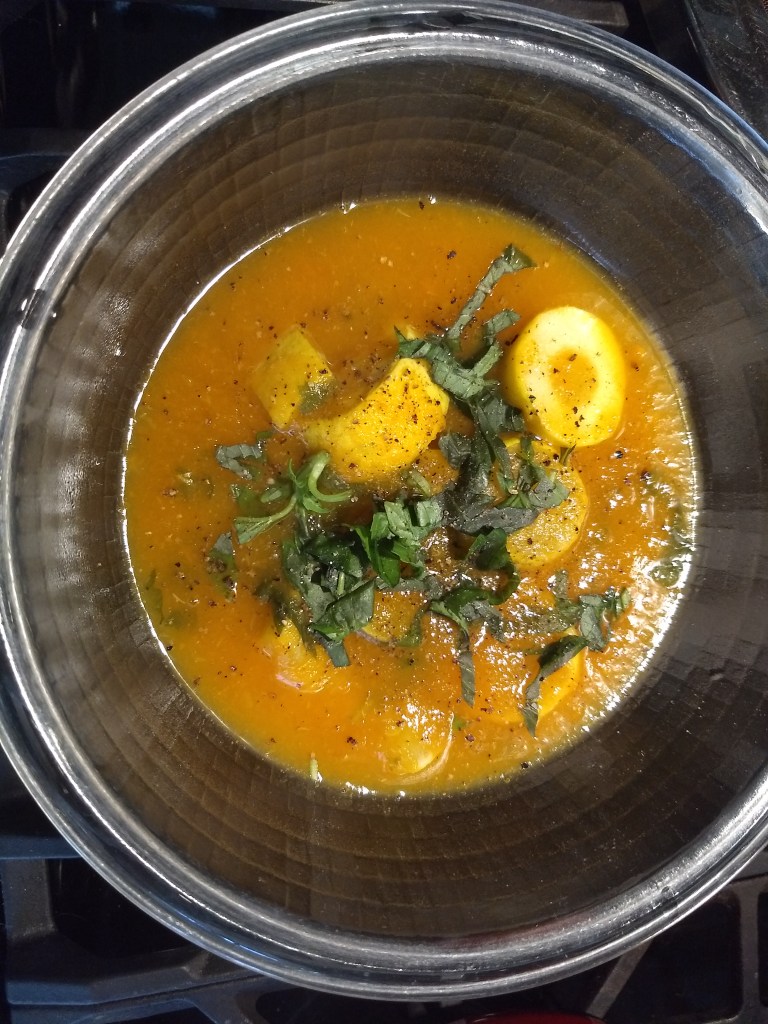
All I Eat Is Smoothies Recipe

  • 3 bananas
  • 1 cup blackberries (frozen or not)
  • Water to get the blender going

Do you desire something else in your smoothie?

  • 2T hemp seed
  • 1T chia seed
  • 1 cup spinach (you probably won’t taste it)
  • 1 cup fresh strawberries (you know the frozen ones will break your blender)
  • 1/2 cup wild blueberries
  • OJ instead of water
  • Nut milk instead of water

You can add any of those things. No one is watching. No one is judging you. If you add all of them, I hope you have a big blender, or a mop.

Brought to you by, I spent my life savings at Jamba Juice my freshman year of college, 2003. So I know a good smoothie damnit.

Here is how capitalism caused my Crohn’s disease.

1) It is socially acceptable and commercially encouraged to eat a diet high in meat, fat, and processed foods. This diet is driven by advertising. This diet contributes to higher rates of Crohn’s disease.

2) Big pharma can’t monetize vegetables, so they have no incentive to get people to eat the foods that lower the risk/protect us from Crohn’s disease. (although Monsanto is trying to patent broccoli apparently.)

3) There has been a correlation/positive association between MAP (a bacteria that causes a Crohn’s like illness in cows and other ruminating livestock) and Crohn’s disease in humans. MAP is in drinking water and dairy products, and survives chlorination and pasteurisation. If MAP infection indeed does cause Crohn’s disease, we will continue to see increased levels of Crohn’s disease as long as we continue industrial factory farming of livestock.

4) Industrialized agriculture and chemical fertilizer and pesticide use has destroyed much of the soil microbiome of our farmland. The soil microbiome influences our gut microbiome when we eat fruit and vegetables. This also means our fruits and vegetables have less nutrient density than they have in the past. As long as industrial monocroping and big agriculture continue, shifting the caloric intake of our society to wheat, soy, and corn, we will continue to see rising rates of Crohn’s disease and gut disbiosis.

And this is why, for the health of our species and our planet, and myself, we have to destroy industrial capitalism.

Riding the Flare & Dietary Interventions for Crohn’s Disease

I’m about 3 weeks into this flare. Had a great talk with my primary care doctor where we discussed my long term health goals and I shared with her my research on treating Crohn’s with diet. She is incredibly supportive and promptly ordered a bunch of tests to assess my micronutrient levels and try to unwind my thyroid situation.

Unsurprisingly, I am deficient in a number of key nutrients for thyroid function, as well as B12 and iron anemic. I have picked up a few over the counter supplements: sublingual vegan B12, Omega-3 from flax, in addition to the Vitamin D and iron I was already taking. I am waiting to speak with a nutritionist and functional medicine doctor in June to get deep into supplementation.

I am attempting to end this flare with partial enteral nutrition (read: complete meal replacement drink) and a plant based whole food diet. For the first 6 weeks I am getting half of my daily calories from complete nutrition drinks (vegan options from Kate Farms and Orgain), and the rest of my diet is following the Crohn’s Disease Exclusion Diet.

  • Green banana (resistant starch)
  • Cooked and cooled potato (resistant starch)
  • Apple (soluble fiber)
  • Various other easy to digest fruits and veg: carrot, cucumber, herbs, spinach, berries, avocados

That is not a complete list of the foods allowed on the diet, but what I am most frequently eating day to day.

So how is it going? How do I feel?

I feel like I’m sick with a crohn’s flare!

Fatigue, loose stool between 4-7 on the Bristol Scale, malaise, weird smelling gas and stool, brain fog, the usual. Interesting to note that I cut out coffee, sugar, and refined grains at the beginning of the flare then had a week of terrible brain fog and fatigue. Those symptoms have abated and I feel that has been a major improvement.

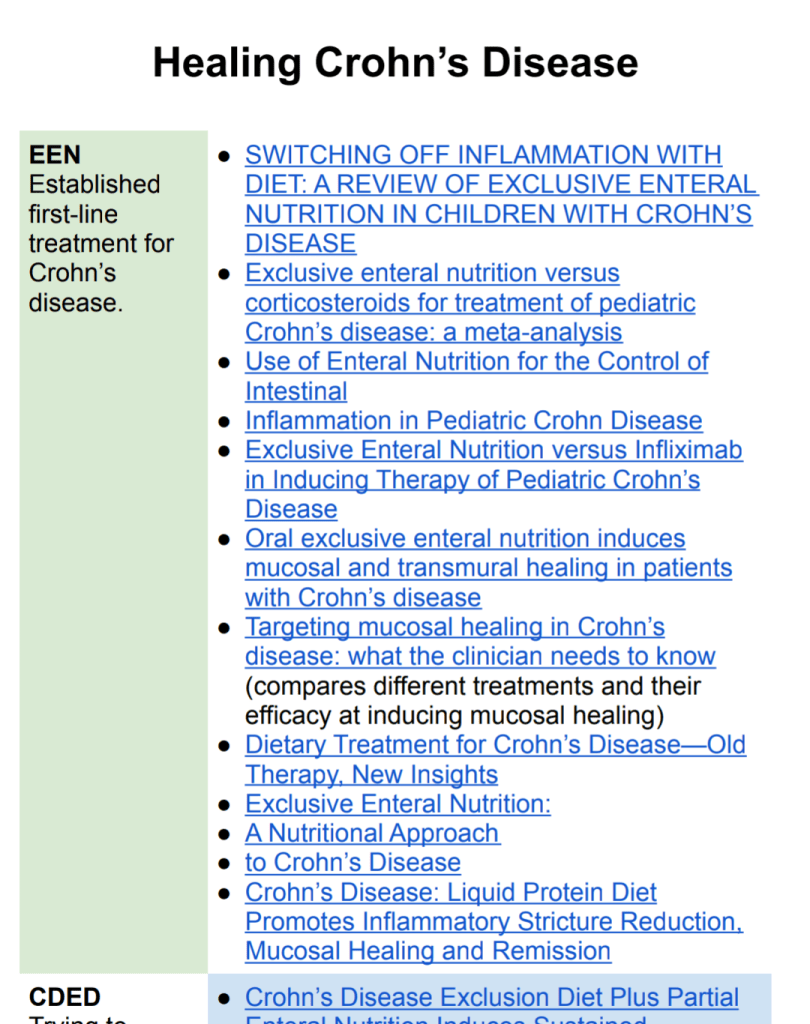
Studies suggest EEN, as well as CDED and CD-TREAT diets, can induce remission in as little as 3-6 weeks. These dietary interventions have no negative side effects, unlike steroids. These treatments also induce mucosal healing, which steroids do not.

Complete nutrition is expensive, costing me about $500 for 6 weeks of drinks (990 calories a day for me). A reminder that one infusion of Remicade costs at least $30,000 or more, depending on hospital charges. And complete nutrition from Kate Farms and Orgain specifically eliminates the most common allergins, so unlike Remicade, it does not trigger an anaphylactoid reaction. No intravenous benadryl or steroids needed to tolerate this medicine.

I have completed 2 weeks of this 6 week treatment. I hope to report positive results in another month.

The following link will take you to my research on dietary interventions for crohn’s disease.

Flare #3

Acceptance that something is wrong in the state of your colon.

Action plan develops. Grocery shop for flare foods. Make an appointment with your doctor. Keep up with food diary and go over your data, again.

Deflation. Reliving medical trauma. Activate PTSD. Depression. Feeling like you have done this to yourself. Feeling there is no hope. Wondering when you will have surgery. Ostomy fear.

Everything seems inevitable, incurable, and the lack of agency in the direction of my treatment is very troubling.

But of all of it, the timing is the worst. A year of quarantine and we are finally ready to go back to school in a hybrid capacity! So much hope and excitement and feeling of responsibility to really nail it for the remainder of the year. And then you aggressively shit 3 times in an hour and all of the energy and vitality drains out of you.

It sure feels like a dead end, but somewhere under the upsetting and terrified feelings is some kind of hope that we, me and my colon, can get better.

Time to sign up for FML AYYYYYY

The Hype

Whole food plant based eating has a lot of hype around it. It is marketed as a weight loss technique and a cure all for chronic lifestyle illness, such as high blood pressure or diabetes. Does WFPB pass muster?

Eating plants does have benefits to your health, namely high fiber, low calorie, and nutrient density. And it seems that for most people, when they cut oil and other refined foods from their diet, they can easily lose weight without cutting portions.

But some caveats. Eating fruits and vegetables for the bulk of your diet has an impact on satiety. You have to work in whole grains, legumes, and starchy vegetables in order to feel full. This is a skill and takes time to master. Being hungry all day sucks, it sucks your energy, and it is a pretty quick way to revert to your old eating habits.

Some chronic illnesses, such as hypothyroidism, will not be impacted by a WFPB diet. I basically stand no chance of losing weight when the thing that runs my metabolism is broken. Being mindful of how certain foods affect chronic illness is still a concern with WFPB. Grapefruit is a key example of a food that has interactions with numerous medications. Far from a cure all for chronic illness, Whole Food Plant Based eating may have little or no impact on your chronic illness, depending on what it is.

Is there still a health benefit to eating mostly plants? Absolutely. And there is a growing amount of scientific literature on the topic. Search “vegan” or “plant based” on the National Institute of Health for current scientific research.

So what about Crohn’s disease? That is my point of inquiry. For me personally, it was easy to switch to WFPB. I had been vegan and vegetarian for years. I grew up eating a variety of fruits, vegetables, grains and legumes. I have not been lacking in inspiration for how to chomp down these plants.

It has been a year and a half since I stopped getting Remicade infusions. I was in remission when I stopped Remicade. I stayed in remission for over a year, then had a mild flare in July and August of 2020. (This was probably precipitated by stress eating freezer pizza and vegan ice cream because …2020.) My guts recovered in September. In January I started having signs of an increasingly healthy bowel.

So it appears, in this early course of my journey with Crohn’s, that eating a Whole Food Plant Based diet has helped me manage my disease, and achieve and remain in remission following an 8 week steroid course during my flare.

I’m not drinking the kool aid, however, and I am, as always, skeptical of diets and health fads. I would not be terribly surprised if my colon sought it’s revenge in unknown ways. But, let’s be real, when the advice is EAT PLANTS…that’s a pretty basic, no nonsense, common sense approach to a more healthy life.

So, eat more plants.

CDED Reflections

So I tried to manage my last Crohn’s flare with diet, and a heavy dose of steroids. I tapered off the steroids and did not have a relapse of symptoms. I believe this is because (1) steroids are a cheap, widely available, and effective treatment for Crohn’s flares, and (2) diet has an impact on gut health and functioning.

I am in clinical remission, but not “deep” remission because I do not want to get another colonoscopy, so it is unknown what is going on in my guts. So endoscopic remission is unverified.

I found that, while on the steroids, my symptoms fluctuated depending on diet. I found that the Crohn’s disease exclusion diet (CDED) has helped my symptoms, both during a full blown flare and when I eat something that messes up my guts.

For the most part, I am now on the Crohn’s disease maintenance diet, eating whole foods plant based the majority of the time. I mostly eat unprocessed vegan meals that I cook at home. I have tried to limit restaurant food to once a week, as I am trying to eat a diet very low in processed oils.

If I experience Crohn’s symptoms, I return to the basic Crohn’s disease exclusion diet, and I eat the mandatory foods: 2 baked and cooled potatoes, 2 bananas, and an apple. This usually corrects the issue in a few days.

White rice is a go-to food all the time, a common restaurant food, and pairs well with basically all cuisine. I get more than enough fiber from lentils, beans, and vegetables, and haven’t needed to switch to strict whole grains.

White rice is often parboiled, which gives it a shorter cooking time than brown rice, and it’s super easy to throw a meal together in 25-30 mins by cooking a rice mix and throwing in coarsely chopped vegetables.

I would like to get my blood work done again to see how my levels are, but the Rona makes that hard. I may get those labs done the next time I get my thyroid checked.

Design a site like this with WordPress.com
Get started